The Hidden Cost of 'Free' Token Loans
The Pitch You've Heard Before
A market maker sits across from you and offers to provide liquidity for your token. They'll quote tight spreads on six exchanges, build out your order books, and support your listing strategy. The best part? No upfront cost. They just need a token loan — a few percent of supply, returned at the end of the term. Free liquidity.
Except it isn't free. What that proposal actually contains is a set of embedded call options on your treasury, priced by a derivatives desk and structured to extract real economic value from your project. The market maker knows exactly what those options are worth. Most founders don't.
This knowledge asymmetry is the single largest structural advantage market makers hold in token deal negotiations. The mechanics aren't complicated — they're just not widely understood outside of trading desks. The way I think about it: if you can't price what you're giving away, you can't negotiate what you should get back.
What a Token Loan Actually Is
The standard market-making deal works like this: a project lends tokens to a market maker for a fixed term (typically 12 months). The MM uses those tokens to provide liquidity — quoting bids and offers across multiple exchanges. At the end of the term, the MM either returns the tokens or exercises a call option to keep them at a predetermined strike price.
That call option is the cost of the deal. It gives the market maker the right, but not the obligation, to purchase your tokens at the strike price. If your token appreciates beyond the strike, the MM exercises and keeps the difference. If it doesn't, they return the tokens and walk away.
This is a European call option, and it can be priced precisely using the Black-Scholes-Merton framework — the same model that underpins derivatives pricing across every institutional trading desk. The formula itself is straightforward:
C = S × N(d1) - K × e^(-rT) × N(d2)
Where S is the current token price, K is the strike price, T is the time to expiry in years, r is the risk-free rate, and N(d1) and N(d2) are cumulative normal distribution values that capture the probability-weighted outcomes. The critical input — the one that drives most of the option's value — is sigma (σ): annualized implied volatility.
So what does this actually mean for a founder?
The Numbers: An Illustrative Example
To illustrate the magnitude, consider a hypothetical project with the following characteristics:
- Token price: $1.00
- Total supply: 1 billion tokens
- The project lends 2% of total supply (20 million tokens, $20 million notional) for 12 months
- Call option struck at 150% of the current price ($1.50 strike)
- Risk-free rate: 5%
The question is: what is that call option worth? The answer depends almost entirely on volatility. And here's where it matters — mid-cap crypto tokens routinely trade at 70-120% annualized IV. Some trade significantly higher.
Running the BSM model at four volatility levels:
At 50% IV, each token's embedded option is worth approximately $0.082 — the total option value across the full loan is roughly $1.65 million, or 8.2% of the loan's notional value. At 70% IV — a reasonable base case for a mid-cap token with established exchange listings — the option value jumps to $0.158 per token. That's $3.17 million total, or 15.8% of what you loaned out. At 100% IV, which isn't unusual for newer tokens or those with concentrated ownership, the option is worth $0.278 per token — $5.55 million total, representing 27.8% of the loan. And at 150% IV, which captures the reality for many early-stage or thinly-traded tokens, the option value reaches $0.465 per token. That's $9.30 million, or 46.5% of the loan.
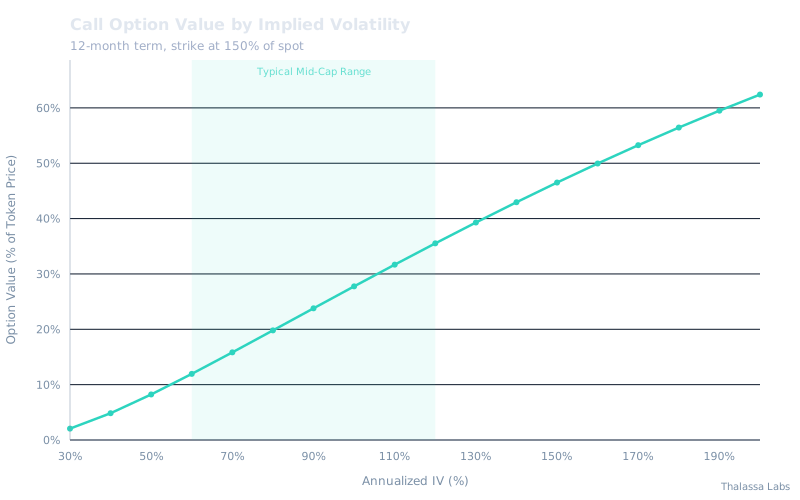
There's a self-reinforcing dynamic at work here. The tokens that need market-making the most — early-stage, illiquid, volatile — are precisely the ones where the embedded options are worth the most. The vol is elevated because the token is illiquid and early-stage, which makes the options expensive, which means the "free" loan is actually transferring a larger share of value. Founders of the most volatile tokens are paying the highest hidden cost.
The fairness bands we use internally reflect this reality: an option value below 15% of the loan is favorable for the founder. Between 15-25% is the typical range for established mid-cap tokens. Above 25% starts getting expensive. Above 40% is a deal that heavily favors the market maker.
Tranche Structures and Compounding Costs
Most proposals don't include a single option tranche. They include two, three, or four tranches at different strike levels — and the structure matters enormously.
The intuition is straightforward: lower strikes are worth more. A call option struck at 125% of the current price (only 25% out of the money) has a much higher probability of finishing in the money than one struck at 200%. When a proposal front-loads its tranche allocation toward lower strikes, the aggregate option value compounds quickly.
Consider an illustrative $200 million FDV token at $0.20, with a three-tranche deal structured as follows: 1% of supply at a 125% strike, 1% at 150%, and 0.5% at 200%. At a base case of 70% IV, the near-the-money first tranche generates the bulk of the option value. At 120% IV — not uncommon during volatile periods — the total cost scales significantly because higher vol amplifies the value of every tranche, but especially the lower-struck ones.
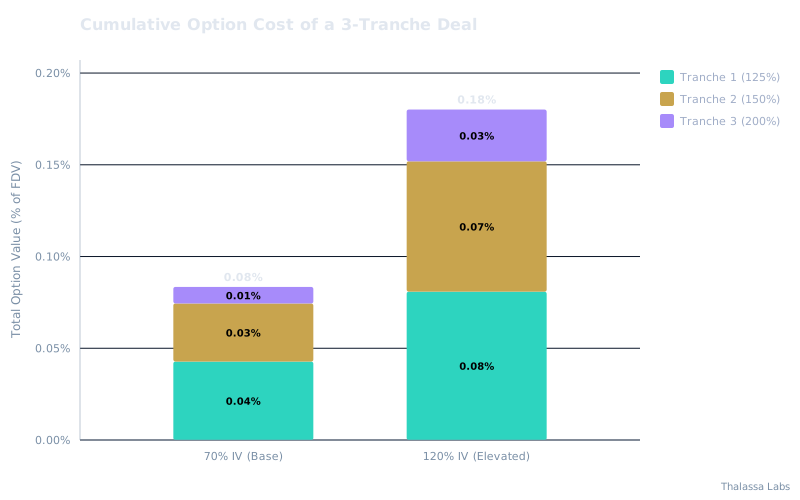
This is where deal structure reveals intent. A market maker that proposes three tranches at 125%, 140%, and 160% is asking for something fundamentally different than one proposing 150%, 175%, and 200% — even if the loan size is identical. The weighted-average strike is the number that matters. In practice, we see proposals where the lowest tranche is struck as low as 110-120% of the current price. At that level, the option is barely out of the money. For a volatile token, that's essentially an at-the-money call — and it's priced accordingly.
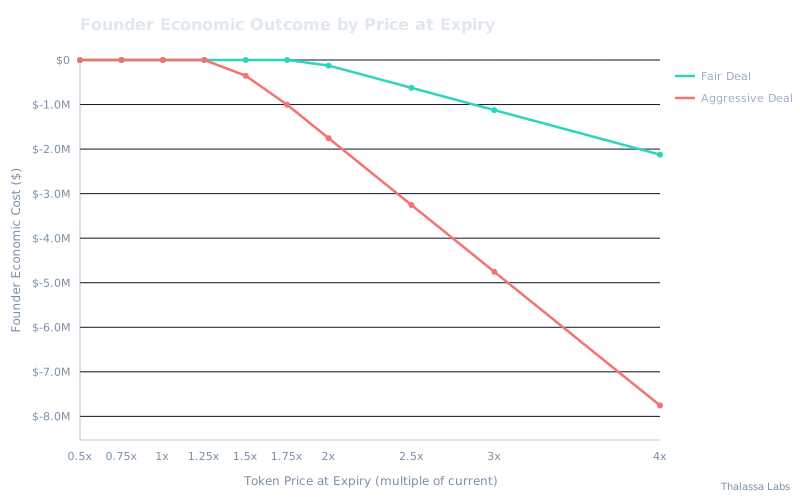
The economic outcomes diverge dramatically at different price levels. A deal with higher strikes and fewer tokens creates a modest cost curve that only becomes meaningful if the token appreciates substantially. An aggressive deal — lower strikes, more tokens, more tranches — generates founder cost at much lower price appreciation thresholds and scales steeply from there.
What Proposals Don't Tell You
Now that the pricing framework is clear, here's what to scrutinize in any market-making proposal:
Vague strike language. If the proposal describes strikes as "to be determined" or "based on market conditions at signing," you're being asked to sign a blank check. The strike is the single most important determinant of option value. It should be fixed, specific, and expressed as a percentage of a clearly defined reference price.
No vol assumption disclosed. Market makers know what vol assumption they're using to price the deal internally. If they don't share it, that's informative in itself. Ask directly: "What annualized vol are you assuming for this token?" The answer tells you how they're valuing the options they're receiving.
TWAP reset provisions. Some proposals include time-weighted average price (TWAP) mechanisms that reset the strike to a recent average price partway through the term. If the token has declined, this effectively lowers the strike — increasing the option value at the founder's expense. TWAP resets that only adjust downward are one-sided. Look for the exact conditions under which the reset triggers.
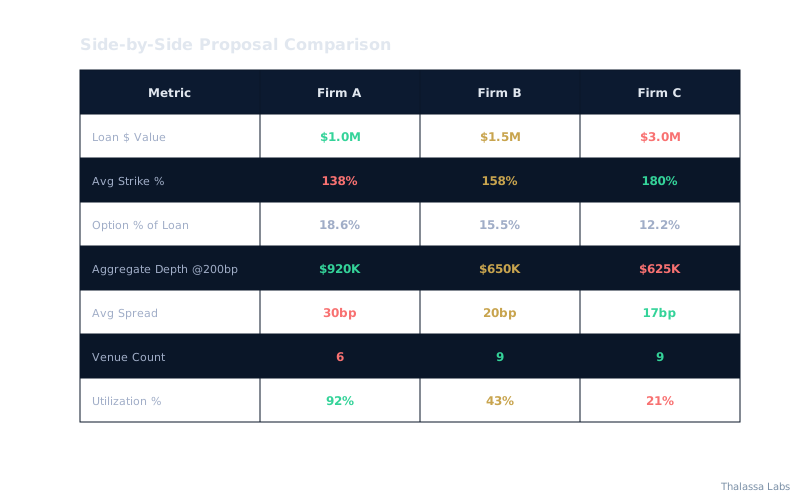
Excessive loan size relative to supply. For a token with a fully diluted valuation under $200 million, typical loan sizes range from $1.5 million to $3 million. Loans exceeding 1.5% of total supply should be examined closely — the question is whether the market maker needs that much inventory to provide the depth they're committing to, or whether they're maximizing their option exposure.
Exercise mechanics that aren't clearly defined. Can the MM exercise individual tranches independently? Can they exercise early, or only at expiry? Is exercise physical (they keep the tokens) or cash-settled? Each of these details affects the real cost.
How to Negotiate
The leverage in these negotiations comes from understanding the pricing. Once you can quantify what you're giving away, you can articulate what you should get back. Here are the concrete levers:
Push for higher strikes. The difference between a 150% strike and a 175% strike is substantial in BSM terms. At 70% IV on a 12-month option, moving the strike from 150% to 175% reduces the per-token option value by roughly 30-40%. Above 175% is favorable territory for the founder. This is the single highest-impact negotiation lever.
Shorten the term. Option value is positively correlated with time to expiry. A 12-month option is worth meaningfully more than a 6-month option at the same strike and vol. If the MM is performing well, you can always renew. Shorter initial terms limit your downside and create natural review points.
Reduce the number of tranches. Every additional tranche at a lower strike adds option value. A two-tranche deal at 160% and 200% is cheaper for the founder than a four-tranche deal that includes 125% and 150% rungs. Push to consolidate tranches at higher strikes.
Cap loan size to FDV-appropriate ranges. The loan should be sized to support the depth commitments, not to maximize the market maker's option exposure. For tokens under $50 million FDV, $500K to $1.5 million is typical. For $50-200 million FDV, $1.5-3 million. For $200-500 million, $2-5 million. If the proposed loan is above these ranges, ask why.
Demand strong KPI commitments tied to the loan. The option value is the price the founder pays. What do you get back? The answer should be specific, measurable performance commitments: spread targets, depth at multiple bands from mid-price, uptime requirements, and per-exchange reporting. If the KPIs are vague or aggregated across venues, the market maker is leaving themselves room to underperform on individual exchanges without consequence.
Include clawback or penalty provisions. If the MM consistently misses their KPI targets, the founder should have recourse. This can take the form of reduced loan allocations, forfeited option tranches, or early termination rights. Without accountability mechanisms, KPI commitments are aspirational, not contractual.
The Takeaway
Every market-making proposal that includes a token loan with call option tranches is transferring measurable economic value from your treasury to the market maker. This isn't inherently unfair — market makers provide a real service, and they need to get paid. The question is whether you're paying a fair price for the service you're receiving.
The framework for answering that question is the same one that every derivatives desk uses: Black-Scholes pricing, applied to the specific terms of your deal. Once you can compute the option value at realistic vol levels, you can compare it against the KPI commitments you're receiving, benchmark it against typical deal structures at your FDV tier, and negotiate from a position of knowledge rather than trust.
The absence of this quantitative framework is what allows "free" to persist as a marketing pitch. The math doesn't lie. The question is whether you've run it.
Chris Newhouse is the founder of Thalassa Labs, an independent research and education initiative focused on advancing public understanding of crypto derivatives and market structure. Learn more at thalassalabs.xyz.
