Reading the Vol Surface: What Skew Tells You About Positioning
A Single Snapshot That Contains the Market's View
Every Friday afternoon, most of the crypto market is staring at the same thing: price charts, funding rates, maybe open interest. These are useful inputs, but they're lagging indicators — they tell you where people have already positioned, not how the market is pricing what happens next.
The vol surface tells you something different. It's the market's probabilistic view of future price action, revealed through how much participants are willing to pay for optionality at different price levels and timeframes. It doesn't predict direction — nothing does reliably — but it reveals the positioning landscape that will shape how the next catalyst plays out. The way I think about it: the vol surface is a map of where the market's collective hedging demand, speculative interest, and structural flows are concentrated. If you know how to read it, you're seeing information that most participants are ignoring entirely.
The Building Blocks
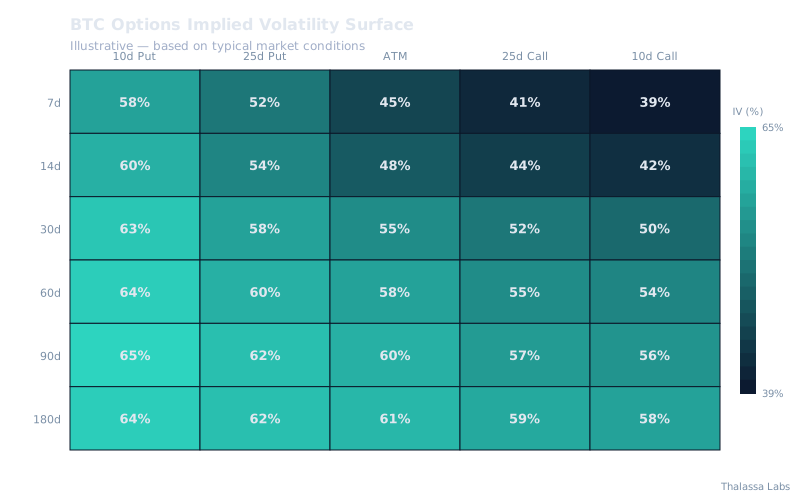
The vol surface has two axes that matter. The first is the term structure: ATM implied volatility across different expiries. When you compare 7-day constant maturity IV against 30-day, you're looking at how the market prices near-term uncertainty relative to medium-term expectations. The shape of this curve — whether it's upward-sloping, flat, inverted, or front-heavy — tells you about the distribution of expected risk across time.
The second axis is skew: how IV varies across strikes at a given tenor. This is measured by the risk reversal (call IV minus put IV; negative means puts are elevated). A 25-delta risk reversal of -8% means the market is paying 8 IV points more for 25-delta puts than for equivalent calls. That premium reflects hedging demand, directional conviction, or both — and decomposing which one is doing the work is where the analytical value lives.
These two axes interact. A vol surface that's front-heavy (short-term IV above long-term) with steep negative skew at the front end tells a different story than one that's upward-sloping with flat skew throughout. The first is a market bracing for near-term impact. The second is a market that expects things to stay calm in the short run but is pricing increasing uncertainty further out.
Skew as a Positioning Signal
Here's the core thesis: short-term skew reflects positioning and hedging pressure. Long-term skew reflects narrative and structural sentiment. The two move on different timescales and respond to different catalysts, and conflating them is one of the most common analytical errors.
Front-end skew — the 7-day and 14-day risk reversals — moves on flow. When a large fund needs to hedge a spot position ahead of a known catalyst, they buy short-dated puts. When a market maker needs to cover a short gamma exposure, they reprice their short-dated quotes. These flows show up as rapid shifts in weekly skew that can move 5-10 points in a single session. This is reactive, tactical positioning. It tells you about near-term hedging demand, not about anyone's six-month view.
Back-end skew — the 90-day and 180-day risk reversals — moves on conviction. When institutional allocators are structurally bullish, they sell long-dated puts (compressing back-end put skew) or buy long-dated calls (lifting back-end call skew). These flows are persistent, slow-moving, and reflect genuine directional views rather than hedging mechanics. When back-end skew is flat or slightly positive even while front-end skew is deeply negative, that's a market expressing near-term fear but structural optimism. The absence of put demand at longer tenors is as informative as its presence at shorter ones.
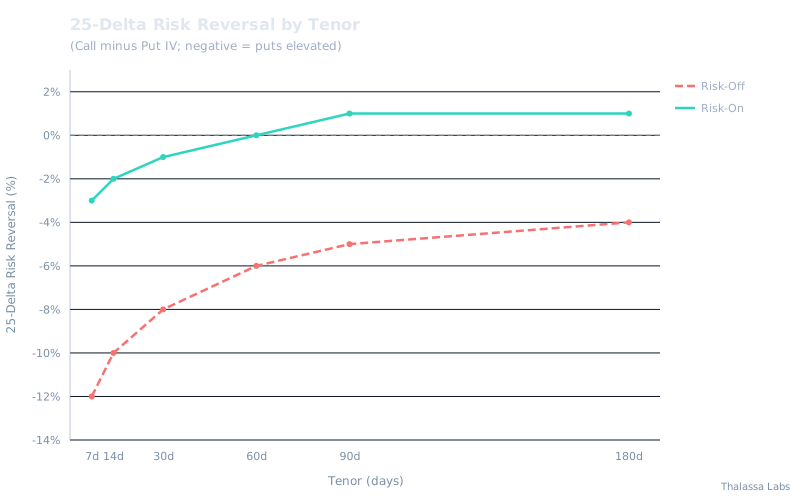
What matters here is reading both sides of the equation. Elevated put skew isn't just about demand for puts — it's also about the absence of demand for calls. When nobody is buying upside, the ask side of the call market gets cheap, which mechanically widens the risk reversal. A steeply negative risk reversal driven by heavy put buying looks the same on the surface as one driven by call-side apathy, but the implications are different. The first suggests active hedging against a specific risk. The second suggests a lack of conviction about the upside — which is a more structural, and often more persistent, signal.
Term Structure Regimes
The shape of the ATM IV term structure across tenors encodes the market's view on how risk is distributed over time. There are four shapes that matter:
Upward-sloping is the default state. Longer-dated options cost more in IV terms because there's more time for things to happen. This is the surface at rest — no particular near-term catalyst being priced, no acute fear. In this regime, the market is saying: "We expect normal volatility, and we're willing to pay a modest premium for the additional uncertainty that comes with longer time horizons."
Front-heavy (or inverted — short-term IV above long-term) signals that the market is pricing imminent risk. This typically appears around known catalysts: FOMC meetings, major token unlocks, quarterly expiries, or acute market dislocations. The front-end IV spikes because participants are buying short-dated protection or gamma, while the back end remains anchored to longer-term expectations. The size of the inversion quantifies the market's assessment of event-specific risk.
Flat term structure is often the most uncomfortable regime for vol traders. It means near-term and long-term uncertainty are being priced equally — there's no clear catalyst distribution, no structural view driving differentiation across tenors. In practice, flat term structures tend to appear during prolonged consolidation phases or after a large move has been fully digested but before a new narrative has taken hold.
Kinked term structure shows a localized spike at a specific tenor — typically the expiry closest to a known event. An FOMC meeting next Wednesday creates a visible kink at the 7-day point that dissipates across the 14-day and 30-day tenors. The kink's magnitude tells you how much event-specific vol the market is pricing, distinct from background realized vol.
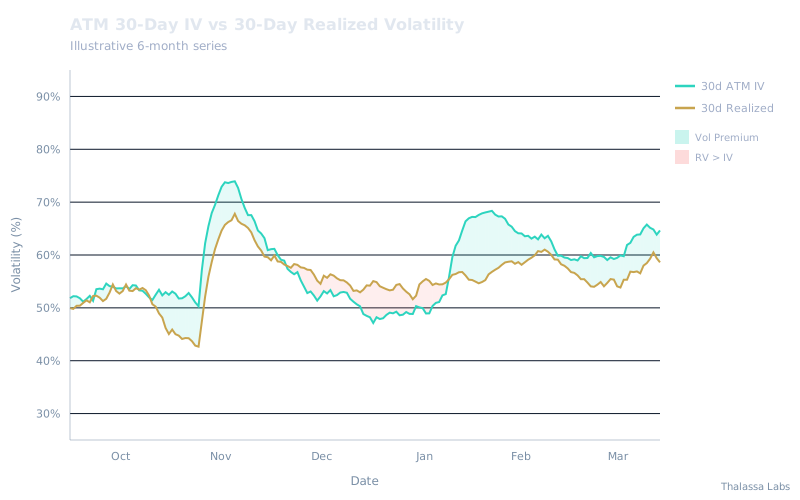
The relationship between ATM IV and realized vol at any given tenor is itself a signal. When 30-day ATM IV trades significantly above 30-day realized vol, the market is paying a premium for protection — the vol risk premium is positive, and options are relatively expensive. When the vol risk premium compresses toward zero or goes negative (realized vol exceeding implied), protection is cheap and the market may be complacent. These dislocations don't persist indefinitely, but they create opportunities for those paying attention.
Dealer Gamma and Its Market Impact
The vol surface doesn't exist in a vacuum. It's quoted by market makers who are constantly managing their own gamma exposure, and that exposure creates self-reinforcing dynamics that amplify or suppress spot price moves.
When dealers are collectively short gamma — meaning they've sold options to clients and hold the hedging risk — they must dynamically hedge by selling into falling markets and buying into rising ones. This is the opposite of stabilizing. Short gamma concentrations, particularly at specific strike levels where open interest is heavy, create zones where dealers' hedging activity accelerates moves. The larger the short gamma position, the more aggressively dealers need to hedge, and the more their hedging becomes the dominant flow in the market.
What matters here is that gamma exposure isn't binary at discrete strikes. It's continuous across a range, with peak concentrations near strikes where open interest is heaviest. A large open interest cluster at the $60,000 strike doesn't mean gamma flips from negative to positive exactly at $60,000 — it means the gamma pressure intensifies as spot approaches that level, peaks near it, and gradually decreases as spot moves away. Thinking about dealer positioning as a continuous landscape rather than a set of discrete flip points is essential to getting the dynamics right.
Large expiry events illustrate this clearly. When a significant quarterly or monthly options expiry rolls off, the gamma exposure associated with those contracts evaporates. If dealers were short gamma heading into expiry, the removal of that exposure releases the hedging pressure that was pinning or amplifying spot price. The period immediately following a large expiry roll-off is often a directional vacuum — the mechanical forces that were influencing price are suddenly absent, and the market needs to find a new equilibrium.
Put unwind mechanics create a related dynamic that's often misunderstood. When a put buyer closes their position by selling the put back, the dealer who was short that put and hedging it with a short spot position now has an unhedged short. The dealer buys back the short, creating mechanically bullish spot flow. The magnitude of this effect depends on the size and delta of the puts being closed, but during periods of aggressive put closing — often after a fear event resolves — the resulting spot bid can be meaningful. The flow is mechanical, not conviction-based, which means it can create moves that look like bullish sentiment but are actually just plumbing.
Demand for Gamma vs. Demand for Vega
A distinction worth making explicit: demand for gamma and demand for vega are different signals that appear differently on the surface.
Demand for gamma shows up in short-dated options. Traders buying weekly or biweekly options are paying for the right to benefit from near-term moves — they want convexity around an imminent catalyst. This demand lifts front-end IV and steepens the term structure. It's tactical, transient, and typically mean-reverts quickly once the catalyst passes.
Demand for vega — long-dated vol exposure — shows up in options further out the curve. Institutional allocators or structured product desks buying 90-day or 180-day options are making a view on the level of volatility over a longer horizon. This demand is more persistent, less reactive to individual events, and reflects structural positioning rather than tactical hedging.
When both signals are present simultaneously — front-end IV elevated on demand for gamma AND back-end IV elevated on demand for vega — the term structure can appear deceptively flat. But the drivers are different, and they'll resolve differently. The front-end demand for gamma will decay post-event. The back-end demand for vega will persist until the structural positioning changes. Disaggregating these two dynamics is critical to understanding what the term structure is actually telling you.
Putting It Together
Reading the vol surface on any given week comes down to a structured sequence. Start with ATM IV across the 7-day and 30-day tenors: what's the term structure shape, and has it changed? Then look at the 25-delta risk reversals at those same tenors: is skew steepening, flattening, or shifting sign? Third, compare ATM IV to recent realized vol: is the vol risk premium expanding or compressing?
The signal hierarchy matters. Derivatives positioning — what the surface is telling you about hedging demand, gamma concentration, and structural flows — should be the primary input. It sits above leverage and liquidation data, above ETF flows, above macro correlation, and well above narrative and sentiment. The reason is mechanical: positioning creates the flows that move price, while narrative only moves price to the extent that it changes positioning.
What the absence of signals tells you is as important as their presence. A vol surface with no skew, no term structure differentiation, and ATM IV trading at realized — that's a market with no active hedging demand, no event pricing, and no one paying for protection or leverage. That surface describes a market that's either genuinely quiet or deceptively fragile. In crypto, the calm-surface-hiding-explosive-conditions setup — thin liquidity, compressed participation, low vol, no hedging demand — has historically preceded the sharpest moves. The absence of demand for gamma in a market that should reasonably have catalysts ahead is a signal worth paying attention to.
The vol surface won't tell you which direction the market is going. What it will tell you is where participants have positioned for protection, where their hedging activity will amplify or suppress moves, what the market is pricing for specific events, and where the structural flows are concentrated. That's more actionable information than most market commentary provides — and it's sitting in the options market every day, waiting to be read.
Chris Newhouse is the founder of Thalassa Labs, an independent research and education initiative focused on advancing public understanding of crypto derivatives and market structure. Learn more at thalassalabs.xyz.
